Color · 7 min read
Bathroom Paint Colors: How to Choose for Small, Humid Rooms
A bathroom is often the smallest room in the house with the hardest conditions: tile you can’t change, harsh light at the mirror, and steam. Here is how to choose a color that survives all three.
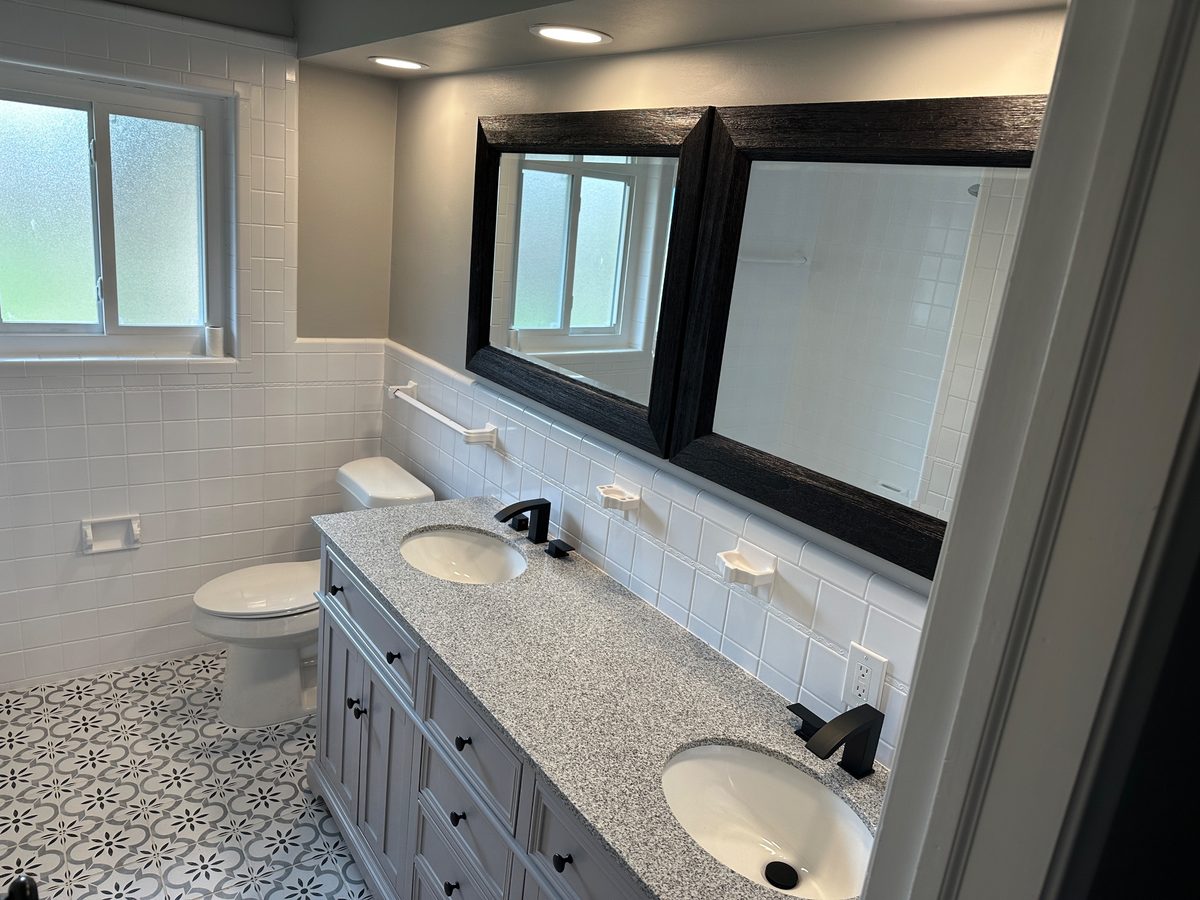
The most dependable bathroom paint colors are soft and light, matched to the tile: a pale green-gray like Sea Salt SW 6204, an airy blue-gray like Upward SW 6239, or a clean white such as Pure White SW 7005. Choose with the tile and mirror light in view, then use a durable satin or semi-gloss.
Key takeaways
- Match the wall color to the tile and fixtures you are keeping, not to a magazine photo.
- Light at the mirror is the real test, so sample next to the vanity with the lights on.
- Soft, light colors like Sea Salt SW 6204 or Upward SW 6239 are forgiving; deep colors work best as a deliberate accent.
- Color matters, but prep and sheen decide whether a bathroom finish lasts through steam and cleaning.
Sherwin-Williams colors in this guide
Jump to a section
- Why are bathroom colors harder to choose than other rooms?
- How do I match paint to tile and fixtures?
- What does mirror and vanity lighting do to color?
- What colors make a small bathroom feel bigger?
- Can I use a dark color in a bathroom?
- What sheen should a bathroom have?
- How do humidity and prep affect the finished color?
- How should I test bathroom paint samples?
- Questions
Why are bathroom colors harder to choose than other rooms?
A bathroom gives you the least wall and the most fixed elements. The tub, tile, vanity top and floor are usually staying, and each one carries its own undertone. Houses from the 1920s through the 1950s are common across Grosse Pointe and Metro Detroit, and some of their bathrooms still have original tile, so the wall color has to get along with it.
Small rooms also magnify mistakes. A color that feels pleasant on a living-room wall can feel heavy when it surrounds you on four sides within arm’s reach. And because a bathroom is often lit by a few fixtures and one small window, the color has less natural light to settle into.
That is why the first step is to look at what is fixed, then choose a wall color that supports it.
How do I match paint to tile and fixtures?
Hold a sample against the tile in the room, not in a store. Look at the tile’s grout, too. White grout in a white tile reads differently than gray grout, and the wall will pick up whichever one dominates your view.
A few reliable pairings, as starting points rather than rules:
- White or off-white tile: most colors work. Sea Salt SW 6204 or Upward SW 6239 gives a spa-like softness; a warmer white like Alabaster SW 7008 keeps things bright and gentle.
- Cream or warm tile: avoid a cool wall that makes the tile look dingy. Greek Villa SW 7551, Shoji White SW 7042 or Agreeable Gray SW 7029 sit comfortably beside it.
- Colored vintage tile: the wall should step back. A neutral that shares the tile’s warmth or coolness usually looks calmer than a second competing color.
- Gray or stone tile: warm greige like Accessible Beige SW 7036 can soften it, while Repose Gray SW 7015 reads cooler.
If the wall and tile clash, the room looks unfinished even when everything is clean. If they agree, the room feels intentional, even when the tile is old.
What does mirror and vanity lighting do to color?
Bathroom lighting is often stronger and more directional than anywhere else in the house. Bulbs beside or above the mirror can pull a wall toward yellow, while cooler bulbs can make the same wall look flat or gray. Our guide to how bulbs and lighting change paint color goes deeper.
Here is a practical check: stand at the mirror and look at the wall behind you with the lights on. That is the color you will see every morning. Then check the wall next to the tub or shower, where you will see it with different light. If the two spots look like different colors, choose a softer, lighter option.
Also notice how your skin looks in the mirror. A wall color reflects onto your face, and very strong greens, pinks or blues can make a person look tired at the vanity. Pale, gentle colors tend to be kinder.
What colors make a small bathroom feel bigger?
Light, low-contrast colors help most. A wall, ceiling and trim in related light tones lets the eye travel without stopping at hard edges. White on the ceiling and trim, such as Extra White SW 7006, which is bright and leans slightly cool, with a pale wall like Sea Salt SW 6204 or Upward SW 6239, keeps a compact room open.
Windowless bathrooms and powder rooms are different. With no daylight, a pale color can read gray and a little lifeless, so a warmer light shade can help. Alabaster SW 7008 and Greek Villa SW 7551 add a gentle, creamy warmth.
Bathrooms in older houses are often fairly compact. In those rooms, the simplest approach is often the most elegant: one calm color, crisp white trim, and a finish that cleans easily.
Painting rooms like this in Grosse Pointe?
Tell us about your home and we’ll be in touch to talk it through.
Can I use a dark color in a bathroom?
Yes, with eyes open. Dark colors in a bathroom look dramatic and can make a windowless room feel deliberate rather than dim. They also show water spots, soap film and toothpaste splatter more readily, particularly in a higher sheen. A mid-range satin tends to be a sensible compromise.
If you would like a deep wall, consider using it on just one side or on the lower half beneath a rail in a room that has one. Indigo Batik SW 7602 and Naval SW 6244 both read as deep blues; Pewter Green SW 6208 is a deep green-gray. All three look different under warm bulbs than under cool ones, so sample them in the actual room.
Deep colors also demand better prep. Any patch that was not primed, any ridge from a skipped sanding, and any lap mark shows more in a dark color. If you are heading in this direction, read our guide to dark and moody interior paint colors first.
What sheen should a bathroom have?
Most bathrooms do well with satin or semi-gloss on the walls and trim, though labels vary, so check the can. Higher sheen tends to stand up to moisture and wipe clean more easily, but it also shows every roller mark and wall flaw. On older plaster with gentle waves, satin is usually kinder than semi-gloss.
The ceiling is its own decision. Many people use flat paint here to hide imperfections, while others choose a moisture-resistant ceiling paint sold for baths (check the label). Whatever you choose, keep the sheen consistent across any one wall so the light does not break the surface into patches. Our paint sheen guide and the general kitchen and bathroom paint overview cover the trade-offs in more detail.
How do humidity and prep affect the finished color?
Humidity affects how long the color stays good. In Michigan, humid summers near Lake St. Clair and cold winters with the windows shut both put steam and moisture into small rooms. A beautiful color on a dirty or damp surface can still peel, blister or let mildew return.
These are the details that separate a bathroom finish that lasts from one that does not:
- Clean first. Soap film, hair-product residue and body oils can cause fisheyes and peeling. Walls should be washed and rinsed, especially around the tub and vanity, with the power off at the breaker and water kept away from outlets, switches and light fixtures. Let them dry completely before anything is filled, taped or primed.
- Mildew is cleaned, not covered. Dark spots need to be cleaned off and the moisture source addressed, or they come back through the new paint. Follow the cleaner’s directions, ventilate the room, never mix cleaning products, and let the wall dry fully before painting.
- Caulk is sound. Failed caulk around the tub, the window and the trim lets moisture get behind the paint. Check the label: silicone caulk is hard or impossible to paint over, while a paintable kitchen-and-bath caulk takes paint.
- Patches are primed. A repaired spot that skips primer shows as a dull patch, even when the color matches.
- The fan works. If steam sits in the room, the finish ages faster no matter how good the paint is. Humid air also slows drying, so run the fan while painting and afterward, and check the label for its temperature and humidity limits.
- Cure time is respected. Paint can feel dry in hours but takes weeks to harden, so go easy on long hot showers and scrubbing at first. See dry time versus cure time.
In a home built before 1978, the existing paint may contain lead, and scraping, sanding or scuff-sanding it, or sanding patches and caulk lines, can disturb it. The EPA’s Renovation, Repair and Painting program requires certified firms and lead-safe work practices for paid work that generally disturbs more than 6 square feet of painted surface per room inside, so read it before anyone starts. Cleanup counts too: the usual guidance is to wet-wipe surfaces rather than dry-sweep, and to use a HEPA-filter vacuum rather than an ordinary household vacuum, which can blow fine dust back into the room (check the EPA’s guidance for details). For a deeper look at preventing peeling and mildew, our guide to painting bathrooms: moisture and mildew walks through the full routine.
How should I test bathroom paint samples?
Screens and printed chips mislead, especially for pale colors that change with every bulb. Paint a large sample, roughly the size of a poster, directly on the wall in the room, or on a board you can move. Put one beside the mirror and one near the tub or window.
Look at it in the morning, at midday and in the evening with the lights on. Check it next to your towels, your tile and the vanity top. If two candidates look alike, pick the one that looks better at the times of day you actually use the room, with the bulbs you actually use. Our guide to testing paint samples at home has a full method.
When you are ready for a plain-English written scope and careful prep on a bathroom or the rest of the house, see our interior painting page.
Questions
What is a good paint color for a small bathroom?
Light, soft colors are the most forgiving. Sea Salt SW 6204 and Upward SW 6239 give a calm, airy look, and a clean white like Pure White SW 7005 keeps things bright. Test samples near the mirror and the tub, because screens and chips can mislead.
Can a small bathroom be painted a dark color?
It can. A short-visit room like a powder room can carry a deep color such as Indigo Batik SW 7602 or Pewter Green SW 6208. A deep color may need extra coats (check the label), careful priming of any patches, and a durable sheen, since water spots show more.
What sheen is best for bathroom walls?
Satin or semi-gloss is common because it tends to stand up to moisture and wipes clean. Higher sheen shows flaws more, so on uneven plaster satin is often the better choice. Always check the label for the specific product.
About the author
Guiffre's Painting Co.
Family-owned interior painting and plaster repair serving Grosse Pointe and Metro Detroit. Owner Bob Guiffre has been painting for more than 37 years — more than 1,800 homes — and his son, Bobby, works beside him on every project. We paint with Sherwin-Williams. Estimates are free. Insured: $1,000,000 general liability. Call (586) 722-3277.