Color · 7 min read
Hallway and Foyer Paint Colors: How to Choose for Dark Halls, Stair Halls and Entries
Halls and foyers are the busiest and often the darkest parts of an older house. The right color has to work in poor light, tie rooms together and stand up to daily wear.
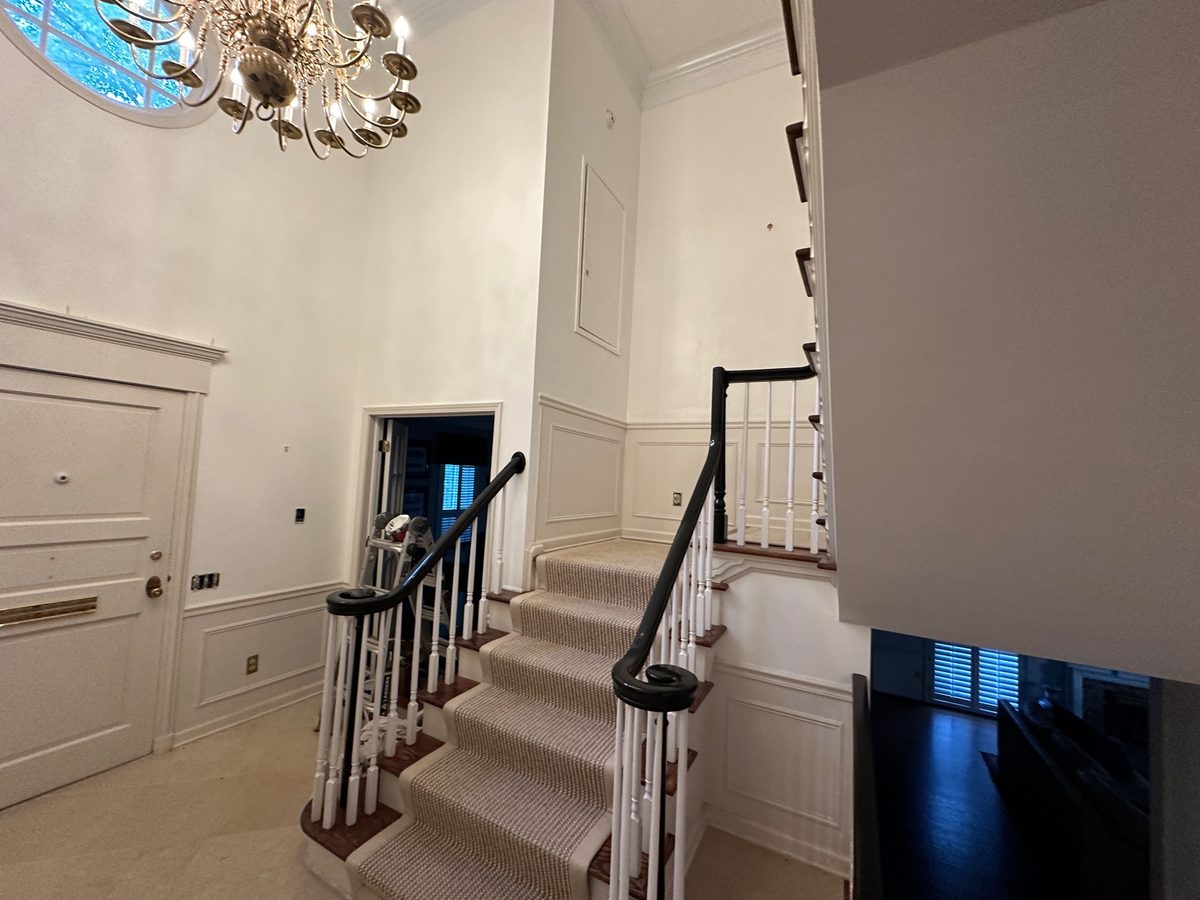
For a hallway or foyer, choose a color light enough to bounce around limited daylight, warm enough to feel welcoming, and quiet enough to sit beside every room that opens off it. Soft neutrals like Accessible Beige SW 7036, Agreeable Gray SW 7029 or Shoji White SW 7042 are common starting points. Test them under your actual bulbs.
Key takeaways
- Halls and foyers often have little natural light, so choose colors with enough lightness and warmth and test them under the actual bulbs.
- Think in sight lines: the hall color is seen with every adjoining room, so it should relate to all of them.
- Use a washable sheen such as eggshell or satin on high-traffic walls, and keep it consistent across each wall.
- Prep matters as much as color in halls, where scuffs, hand marks and patched plaster are everywhere.
Sherwin-Williams colors in this guide
Jump to a section
Halls are the connective tissue of a house. In many older Grosse Pointe and Metro Detroit homes, the foyer and stair hall are where you meet the house’s plaster walls, paneled doors and original trim first, often with few windows and a lot of foot traffic. That combination makes color and finish choices a little different from a living room or bedroom.
Why are hallway colors harder to choose?
A hall has several challenges at once. It often has little or no natural light, especially in a center-hall house where the hall runs between rooms with their own windows. It is seen from many angles and from other rooms. And it takes constant abuse from shoulders, hands, bags and pets.
Because a hall is dim, a color tends to read darker and sometimes grayer than the same color in a sunny room. A color that looked soft on a chip can feel heavy in a stair hall at four in the afternoon. That is why testing in the real space matters more here than almost anywhere else in the house. Our guide to how to test paint samples at home covers the method.
What colors work in a dark hallway?
When daylight is limited, the safest approach is a warm, light-to-mid neutral that reflects as much light as it can. Warm tones add a feeling of welcome that cool grays can sometimes lack in a dim space.
| Color | How it tends to read | Good fit when |
|---|---|---|
| Alabaster SW 7008 | Warm, creamy off-white | The hall is very dim and needs lift |
| Shoji White SW 7042 | Off-white with greige cast | Adjoining rooms are cream or greige |
| Accessible Beige SW 7036 | Warm greige, more beige | You want a grounded, welcoming hall |
| Agreeable Gray SW 7029 | Light warm gray / greige | Rooms nearby use a range of colors |
| Sea Salt SW 6204 | Pale green-gray | The hall gets a little daylight |
Pale cool colors are possible but less forgiving. In a hall with little daylight, a cool gray can turn flat or slightly dingy, especially under cool bulbs. Repose Gray SW 7015, for example, reads cooler than Agreeable Gray and can lean slightly blue or violet in cool light, so it deserves a careful look in your own space before you commit.
How do sight lines affect hallway color?
A hallway color is never seen alone. Stand in the hall and look through each doorway: you will see the living room, dining room or kitchen framed by trim, with your hall color on the edges of the view. If the colors fight, the house feels busy. If they relate, the house feels composed.
You do not need to match the rooms. You need to relate them. A few ways to do it:
- Use a quiet neutral in the hall and let adjoining rooms carry the personality.
- Pick a hall color that appears, in a deeper or lighter form, in the adjacent rooms. A greige hall beside a soft green room can work.
- Keep trim and ceiling consistent so the shared elements tie the rooms together even when wall colors change.
- Test color flow at night. Standing at the front door with the lamps on is the view most guests will have.
Trim and doors do a lot of the work in a hall. Paneled doors, wide casings and a stair railing are seen from every angle, so the pairing of wall and trim is on display everywhere. Two whites to compare are Pure White SW 7005, a soft white with a touch of warmth, and Extra White SW 7006, a bright, crisp white that leans slightly cool.
Our whole-house color palette guide explains how to build a family of colors that flows from room to room.
Painting rooms like this in Grosse Pointe?
Tell us about your home and we’ll be in touch to talk it through.
How should I handle a foyer or tall stair hall?
Some foyers and stair halls in 1920s Colonial Revival and Tudor Revival houses are tall, with a stair, a landing and sometimes a window partway up. Color here plays differently. A tall wall can catch light from a landing window, and the tone shifts as the light moves through the day.
A few tips for tall halls:
- Keep the color continuous up the stair. Changing color mid-wall at a landing rarely looks intentional. If a color has to change, a careful painter breaks it at an inside corner, where a clean line is far easier to hold than on an open wall.
- Be cautious with deep colors. A dark color on a tall wall can make the space feel narrow. If you love a deeper tone, try it in a small foyer with a good light source first.
- Consider the ceiling. A light ceiling lifts the whole space, and flat ceiling paint hides flaws in old plaster.
Painting a tall stair hall is also a safety question. It calls for stable, purpose-built access set up by a professional, not a ladder balanced on the stairs. Our guide to painting stair halls and high ceilings explains what that involves.
What sheen holds up in a high-traffic hall?
Hall walls take scuffs, hand marks and the occasional bump. Sheen is a trade-off: a higher sheen is more washable, but it shows more flaws and highlights waves in old plaster. For most hall walls, eggshell or satin is a sensible middle ground. Flat is kinder to uneven plaster, but it marks more easily and is harder to clean.
Trim in a hall, including baseboards, door casings and railings, gets even more contact. Satin or semi-gloss on trim is typical, and keeping the trim sheen consistent from room to room makes the whole house look finished. Our paint sheen guide goes into the details, and our guide to cleaning painted walls explains how to wash a hall wall without damaging the finish, especially while the paint is still curing.
What prep do halls need before painting?
Halls look simple, but they hide a lot of prep. Walls collect grime at hand height, scuffs near corners, and patched areas where hooks, mirrors and picture rails have been removed. A careful painter cleans the surface first, because grease and hand oils cause adhesion problems, then scrapes loose paint, sands the edges, fills holes and cracks, caulks the joints and spot-primes patches. Unprimed patches “flash” as dull spots under the finish coat, and in a hall lit by a window on the landing, they show.
In a house built before 1978, that scraping and sanding, and the cleanup afterward, may disturb lead paint. The EPA’s Renovation, Repair and Painting (RRP) rule requires certified firms and lead-safe work practices for paid work that generally disturbs more than 6 square feet of painted surface per room inside a pre-1978 home, and the EPA’s program page explains the rules. Read it before you scrape or sand a hall yourself, or before you hire the work out. Where you can, avoid dry sanding and dry sweeping, wet-wipe dust and chips with disposable damp cloths, and use a HEPA-filter vacuum rather than an ordinary household vacuum, which can blow fine dust into the hall and the rooms off it.
A hall is also the route everything travels, so the floor matters. A careful painter protects floors, furniture and plants before work starts, and checks that the protection stays put underfoot. Clearing the walls is the homeowner’s part: take pictures and mirrors down before the painters arrive, and lift a stair runner if you can.
Older plaster adds its own details. Hairline cracks are normal, but loose or hollow areas need to be secured before painting; our guide to loose plaster repair explains how to tell the difference.
How do I pick a final hall color?
Narrow to two or three, paint large samples on the longest wall and near the front door, and check them in morning, afternoon and evening with the bulbs you actually use. Because halls often rely on artificial light, our guide to how bulbs and lighting change paint color is worth reading before you decide.
Before you commit, run this short checklist:
- Stand at the front door at dusk with the hall lights on and look down the hall.
- Stand in each doorway off the hall and look back, so you see the hall color framed by that room’s trim and walls.
- Hold a chip or board of your trim white against the sample, since a hall shows the pairing on every door and casing.
- Check it beside the things that will not change: the floor, the stair runner and the front door.
- Look at it once more late in the day, in side light from a landing window or lamp, to see how it behaves when the light skims the wall.
When you are ready to have the hall painted, our interior painting page explains how we work: floors, furniture and plants protected, Sherwin-Williams paint in even coats, Bob and Bobby on every project, and a final walkthrough with touch-ups, for homes across Grosse Pointe and Metro Detroit.
Questions
What color should I paint a dark hallway?
A warm, light-to-mid neutral such as Alabaster SW 7008, Shoji White SW 7042 or Accessible Beige SW 7036 is a common starting point, because it reflects what light there is and feels welcoming. Test samples in the hall under your actual bulbs, since dim spaces make colors read darker.
Should the hallway match the rooms next to it?
It does not need to match, but it should relate. A quiet neutral in the hall, with consistent trim and ceiling color, lets each adjoining room have its own color without clashing as you move through the house.
What sheen is best for hallway walls?
Eggshell or satin is a sensible middle ground for most hall walls, because it wipes clean better than flat without highlighting every wave in old plaster. Trim usually gets satin or semi-gloss. Check the can for washability and give new paint time to cure before scrubbing.
About the author
Guiffre's Painting Co.
Family-owned interior painting and plaster repair serving Grosse Pointe and Metro Detroit. Owner Bob Guiffre has been painting for more than 37 years — more than 1,800 homes — and his son, Bobby, works beside him on every project. We paint with Sherwin-Williams. Estimates are free. Insured: $1,000,000 general liability. Call (586) 722-3277.